
Welcome to the forth short publication of the Kikulacho Cultures Series™ that discusses popular cultures that may be having a negative impact on your financial well-being. To provide you with a wider view, the series will also include information on who benefits financially from these popular cultures that are ruining the quality of life for many. In a free market economy, individuals make choices and markets respond to the demand. Many of the fastest growing industries today are driven by popular cultures, so this is a big part of the world economy today. It is up-to the individual to be informed on both the short and long term satisfaction they will derive from the life choices they make.
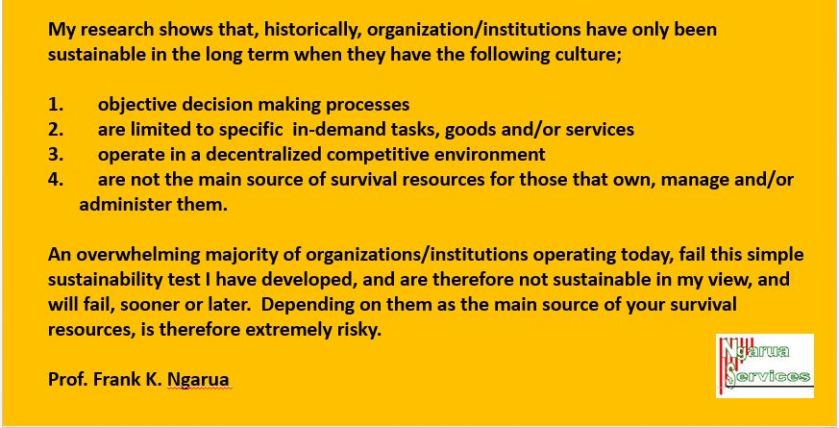
My research shows that, historically, organizations/institutions have only been sustainable in the long term when they have the following culture;
- objective decision making processes
- are limited to specific in-demand tasks, goods and/or services
- operate in a decentralized competitive environment
- are not the main source of survival resources for those that own, manage and/or administer them.
An overwhelming majority of organizations/institutions operating today, fail this simple sustainability test I have developed, and are therefore not sustainable in my view, and will fail, sooner or later. Depending on them as the main source of your survival resources, is therefore extremely risky.
Prof. Frank K. Ngarua
In today’s world, most people are dependent on Institutions for their daily basic needs. Many people today look for employment/contract or business opportunities with institutions in order to provide for their basic needs. These institutions can be categorized into three broad groups, Government/Public institutions, Private/Business institutions, and non-profit institutions. The “industrial revolution” which brought manufacturing and other industries into our lives set in motion this increasing dependency. Before industrialization, peoples way of life revolved around hunting and gathering of wild plants and animals and later clearing and cultivating land and domesticating animals. With the setting up of manufacturing industries, institutions became more prominent in peoples way of life, which has brought us to this point where nearly all our needs are met via institutions today.
ABRIDGED VERSION
(See Prof. Ngarua’s books on Amazon for more information on this topic. Click on the link below to view the books. Commissions earned if a purchase is made on Amazon)


 Habari shujaa